The Long Journey of a Drop in the Water Cycle
Follow one imagined drop through the water cycle and distinguish evaporation, condensation, precipitation, infiltration, and runoff as it moves between places.
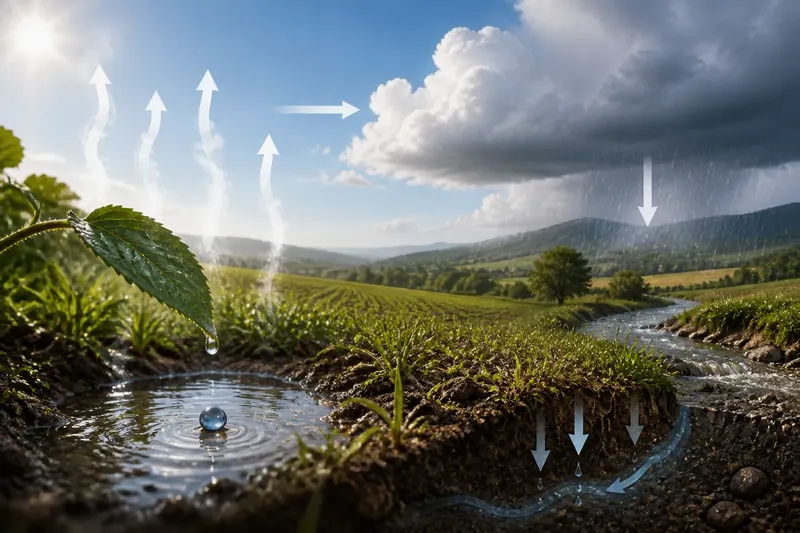
The most common mistake in following a drop through the water cycle is to picture a neat loop from sea to cloud to rain and back to sea. That shortcut can make you miss where water actually goes after it reaches the ground. The water cycle is a set of possible changes in state and location, not a fixed route every drop completes in order.
Say an imagined drop starts in a shallow puddle beside a field. It might enter the air, land on a leaf, soak into soil, or flow toward a stream. The route depends on the conditions around it.
Where does the drop start?
At the start, the drop is liquid water. Its location matters. Water in an ocean, lake, puddle, wet soil, or plant can be affected by different processes, and it may remain in place for a while. The water cycle describes movement through Earth’s surface, subsurface, and atmosphere; it does not require a quick trip.
Sunlight and moving air can transfer energy to the water in the field-edge puddle. When water molecules leave the surface and enter the air, evaporation is occurring. The liquid has changed into water vapor, an invisible gas mixed with the air. The puddle may shrink, but its vapor does not rise as a tiny visible droplet.
Plants provide another route from land to air. They take up water through their roots and release some as vapor from their leaves, a process called transpiration. Evaporation and transpiration together are often called evapotranspiration. A drop might leave an open water surface directly or pass through a plant first.
Which route fits after the drop enters the air?
As vapor, the drop is carried by moving air rather than following a fixed map. It may rise with warmer air, travel sideways, or mix with surrounding air. A cloud forms when moist air cools enough for water vapor to condense onto tiny particles, forming liquid droplets or ice crystals. Condensation changes vapor into liquid water or ice; a cloud is not simply a mass of visible vapor.
If the imagined drop condenses in a cloud, it becomes part of a tiny liquid droplet or an ice crystal. Clouds can move, change shape, or dissipate as their droplets evaporate again. The presence of a cloud alone does not tell you where precipitation will fall.
Use these distinctions to identify the process that fits what you observe:
- Water surface in sunlight: If liquid water leaves the surface and enters the air, identify evaporation; if it remains at the surface, it has not yet evaporated.
- Wet vegetation: If plants release water vapor from their leaves, identify transpiration; if water simply runs off a leaf, follow it as liquid water instead.
- Cooling, moist air: If vapor condenses into droplets or ice crystals, identify condensation; if the cloud thins as its droplets evaporate, the water is returning to vapor.
- Water falling from clouds: If water or ice falls from the atmosphere, identify precipitation; if it remains suspended in a cloud, it has not reached the surface.
- Rain reaching soil: If water enters the ground, identify infiltration; if it flows over the land, identify runoff.
- Water on a plant after rain: If it later evaporates from the plant’s surface, follow it back into the air; if it runs down the plant, follow the liquid toward the ground.
These processes connect, but they are not interchangeable. A cloud contains condensed water or ice. Precipitation falls from the atmosphere, but not every cloud produces it.
What happens when precipitation reaches land?
Imagine the field-edge drop condenses in a cloud and later falls as rain onto the same field. If it lands on a leaf, it may run down the plant or evaporate from its surface. If it reaches bare ground, some may soak into the soil. Water that enters the ground can remain in soil, move downward, or travel through underground spaces. The route depends on the ground and its conditions.
If rain reaches the surface faster than soil can absorb it, or if the ground is already wet or covered by a surface that water cannot readily enter, more water may flow across the land. That flow is runoff. It can gather in shallow channels, enter a ditch or stream, and eventually join a larger river or lake. Runoff is not simply rain moving downhill everywhere: its path depends on the shape of the land and how readily water enters the ground.
A paper towel on a damp counter offers a plain comparison. Water may soak into the towel, remain on the counter, or spread beyond it if the towel cannot absorb what reaches it. Soil is not a paper towel, but the comparison helps distinguish infiltration into the ground from runoff over it.
Which part of the water cycle are you trying to explain?
Why can a drop return to the air without forming rain?
Water can evaporate from a surface and remain as vapor in the air without condensing into a cloud. Even after condensation, cloud droplets may evaporate again instead of falling. The cycle includes repeated changes, not a requirement that every cloud produce precipitation.
Does precipitation always become runoff?
No. Water may soak into soil, collect temporarily on leaves or other surfaces, or evaporate after falling. Runoff is water that flows over land; the route depends on the surface, soil, and conditions at the time.
Can the same drop pass through a plant?
Yes. Water absorbed by roots can move through a plant and leave a leaf as vapor through transpiration. It may later condense, fall as precipitation, and reach the ground again.
Does water always return to the place it left?
No. Air currents can carry vapor and clouds away from their starting point, while streams and groundwater move water across a landscape. A drop may reach a different place or remain in soil, ice, or a body of water before moving again.
How could one drop take more than one route?
Imagine, purely as an illustration, that the field-edge puddle contains one labeled drop of liquid water. First, energy from sunlight allows that drop to evaporate, so it enters the air as vapor. Moving air carries it away from the field; if the air cools enough, the vapor condenses into a cloud droplet. If that droplet falls as rain over the field, the next decision depends on where it lands: on a leaf, it may run off or evaporate; on soil, it may infiltrate or flow across the surface. In this imagined route, suppose it lands on soil that takes in the water. The observable result is that the drop enters the ground rather than joining surface runoff. The route is one possible account, not a prediction for every drop.
To follow any water cycle route, name the change and ask where the water is now: liquid, vapor, or ice; in the air, on land, in a plant, or below the surface. That check keeps evaporation, condensation, precipitation, infiltration, and runoff distinct. The phrase water cycle does not mean the same water must return to its starting point; it describes how water moves and changes along the way.