How Fossil Succession Reveals the Order of Deep Time
Fossil succession helps readers compare rock layers, recognize gaps and establish relative age without mistaking geological order for a calendar date.
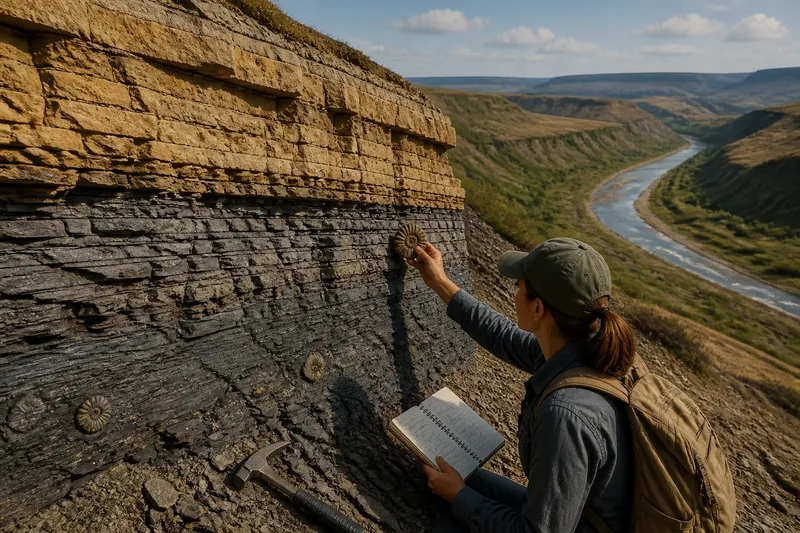
The common mistake in reading a fossil-bearing rock is to treat the fossil’s age as a calendar date. Fossil succession instead helps geologists establish the relative order of rocks and the changing environments recorded in them. That distinction turned scattered outcrops into a usable account of deep time.
How do rock layers establish an order?
In an undisturbed stack of sedimentary rock, lower layers were generally deposited before the layers above them. This principle of superposition gives a sequence, not a clock. A bed beneath another is older in that local stack, provided later forces have not overturned or rearranged the layers.
Those qualifications matter because Earth’s crust bends, breaks, tilts and sometimes turns older rocks upside down. Erosion can remove part of a sequence, leaving a gap. Geologists inspect the rock geometry for clues such as tilted beds cut by flatter layers, faults that offset strata, and erosional surfaces that truncate them.
Imagine a cliff with sandstone above shale in a consistent, undisturbed stack. The sandstone is younger than the shale in that section, but the layers alone do not say how much time separates them. A stack of labeled boxes works as a plain analogy: position gives an order, not a packing date.
What does fossil succession add?
Fossils let geologists compare layers in places where the rocks do not physically connect. Distinctive groups of organisms occur in recognizable sequences through the rock record. The pattern of those changing fossil assemblages is called fossil succession.
A similar, distinctive assemblage in two distant beds can support the inference that the beds occupy comparable relative positions in geological time. The evidence is the combination of fossils and their rock context, not a vague impression that a specimen looks ancient. Assemblages are often more useful than a single fossil because one species may occur across a broad interval.
Fossil succession also connects changes in life to the environments recorded by sedimentary rocks. Shale, sandstone and limestone form under different conditions, and a change in fossils may reflect a shift in habitat as well as a change in which organisms lived at the time. The geological story depends on reading both the fossils and the sediment that contains them.
How are strata correlated between places?
Correlation means matching rock units by physical features, fossil contents, or both. A limestone bed may be traceable along an exposed ridge, while a fossil assemblage may help link beds across a valley where the rock type changes or exposure ends.
Correlation does not mean that every matched layer formed at precisely the same moment. Sediment can accumulate at different rates, and an environment can shift across a landscape rather than arrive everywhere at once. Similar-looking rocks may also belong to different points in a sequence, so color and texture alone can mislead.
Say a naturalist compares a distinctive fossil assemblage in gray shale from one valley with the same assemblage in sandstone elsewhere. The different rock types do not rule out a useful correlation: the fossils support placing the beds in a similar relative interval. The result is a better regional order, not an exact age for either bed.
What can make the record incomplete or misleading?
Rock sequences resemble a book with pages missing. An unconformity marks a break when deposition stopped or older rock was eroded before younger material accumulated above it. A sudden fossil change across that boundary could reflect a long interval missing from the exposed section, rather than an abrupt change in life.
Faults can place older beds beside younger ones or repeat part of a sequence. Folding may tilt or overturn strata. Geologists therefore read bed geometry, contacts and fossil content together instead of assuming that every outcrop runs neatly from old at the bottom to young at the top.
Fossils have their own limits. Some organisms are preserved only in particular environments; others are too widespread or poorly identified to distinguish one interval from another. Fossils can be transported from where the organisms lived, and erosion can redeposit older material in younger sediment. The surrounding rock is part of the evidence.
What does fossil succession tell you about relative age?
Relative dating establishes that one rock or geological event came before or after another. It can show that a fossil-bearing bed is older than an overlying bed, or that a fault formed after the layers it cuts. By itself, it does not supply a duration or a numerical age.
Later methods, including radiometric dating of suitable materials, provided numerical ages and helped calibrate parts of the relative sequence. They complement stratigraphy rather than replacing it: the order of beds and fossils remains essential for interpreting how Earth’s history unfolded.
- Check whether beds form an upright, consistent sequence; if they do, use superposition to order them, but if they are tilted or overturned, determine their orientation before assigning old and young.
- Check whether a fault cuts or offsets the beds; if it does, place the fault after the layers it cuts, but if the contact is unclear, leave that event’s order unresolved.
- Check for an erosional surface or unconformity; if one is present, treat the sequence as incomplete, but if none is visible, do not assume that every interval is represented.
- Check whether the fossils form a distinctive, identifiable assemblage; if they do, use it to compare beds, but if they are widespread or uncertain, rely more on other rock and structural evidence.
- Check whether the same assemblage occurs in different rock types or locations; if it does, consider a relative correlation, but if the match rests only on color or texture, do not treat it as established.
- Check whether fossils may have been transported or redeposited; if the surrounding sediment supports that possibility, avoid using them as a simple date for the bed, but if their context is consistent, retain them as part of the correlation evidence.
Which questions help interpret fossil succession?
Does the lowest fossil-bearing layer always contain the oldest fossils?
Only when the beds remain in their original order and the fossils have not been redeposited. Folding, overturning, faulting and erosion can disrupt the apparent sequence, so the rock structure must be considered.
Can the same fossil occur in rocks of different ages?
Yes. Some organisms occur across broad intervals, which makes a single fossil less precise for correlation. A distinctive assemblage of several identifiable fossils can offer a more useful comparison.
Does a change in fossils mean an extinction?
Not by itself. The change could reflect a different environment, a gap in the record, preservation differences or a real change in the organisms present. Comparing surrounding beds and other locations helps distinguish these possibilities.
Can fossil succession provide an exact age?
No. It establishes relative order and supports correlation, not a count of years. Numerical dating requires additional evidence and methods suited to the materials involved.
How does a worked comparison establish relative order?
Imagine a hypothetical field notebook describing two exposures. At the first, shale lies beneath sandstone, and a distinctive fossil assemblage occurs in the shale. At the second, sandstone contains a similar assemblage, but the beds are tilted and a fault cuts their contact.
The reader first records the shale-below-sandstone order at the undisturbed exposure. Next, the reader notes that the second exposure’s tilt prevents a simple bottom-to-top reading, then uses the fossil assemblage as evidence for comparing its sandstone with the shale-bearing interval at the first site. Finally, the fault is placed after the beds it cuts. The resulting answer is a cautious relative correlation and a later fault event; the exact time separating the beds remains unknown.
Fossil succession is useful because it keeps two questions apart: what came first, and when did it happen? Rock layers and fossils can answer the first with care, even where the second remains unsettled. For readers tracing deep time, that relative order is a substantive result, not merely a date waiting to be filled in.